Krafton's PUBG Universe Expansion: From Battle Royale to Horror and Beyond
Krafton's bold PUBG universe expansion and The Callisto Protocol reveal showcase visionary strategy, diversifying genres and captivating new audiences.
As I sit here in 2026, looking back at the evolution of the gaming landscape, I can't help but reflect on that pivotal moment in late 2020 when Krafton CEO Kim Chang-Han revealed his grand vision. Back then, PUBG was like a magnificent but solitary oak tree in a vast digital forest—impressive, dominant, but standing alone. Chang-Han knew this couldn't last. In his Bloomberg interview, he expressed that familiar creative fear: the dread of becoming a "one-hit wonder." His solution? To transform that single tree into an entire ecosystem.
The announcement laid out a roadmap that felt both ambitious and necessary. 2021 would bring a "new battle royale mobile title" set within the PUBG universe. This wasn't just another port or spin-off; it was a deliberate expansion into the mobile space with a fresh take on the formula that started it all. Then 2022 would deliver a double punch: "another PUBG-related PC and console game" alongside the survival horror title The Callisto Protocol. This latter announcement, made during The Game Awards 2020, sent shockwaves through the community. A survival horror game in the PUBG universe? It was like discovering a secret, haunted chamber in a familiar mansion—the same foundation, but an entirely different atmosphere and purpose.
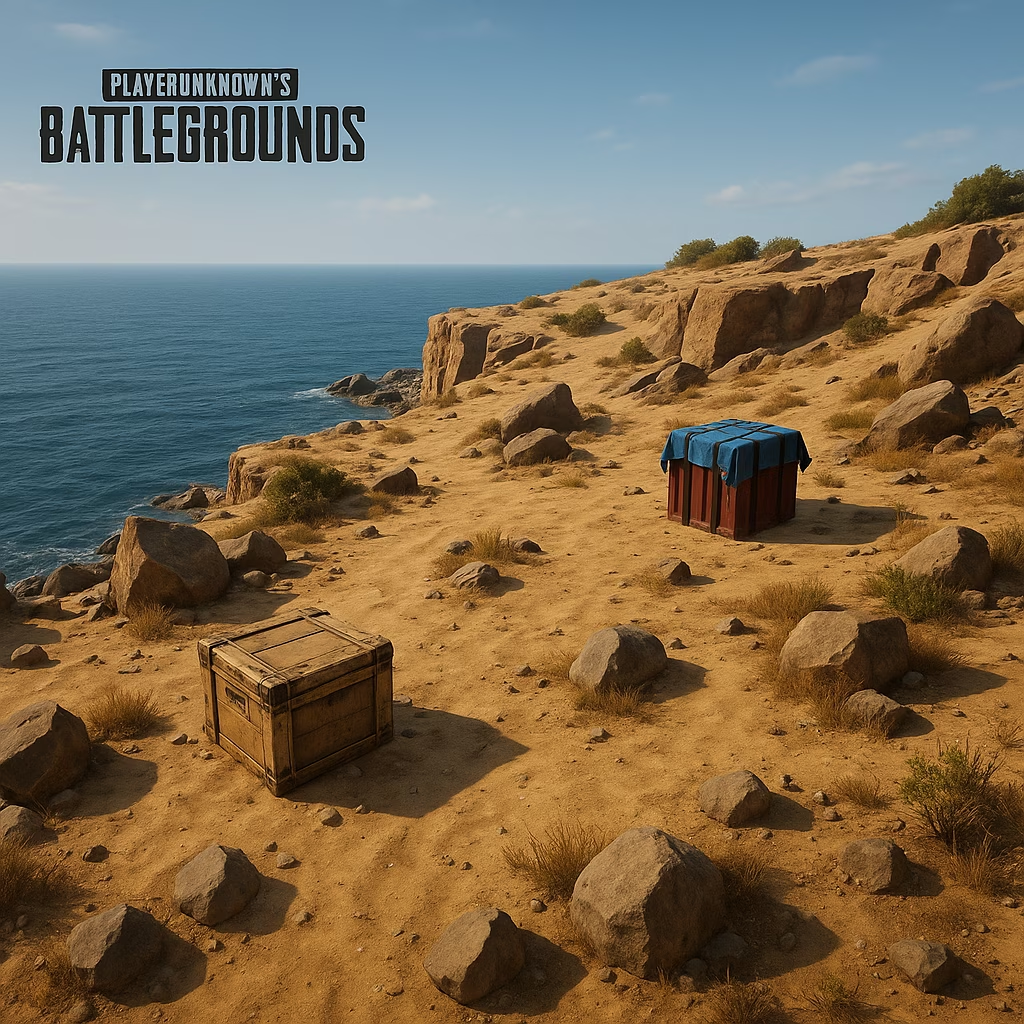
This strategic pivot demonstrated something crucial about Krafton's approach. They weren't just milking a successful IP; they were treating the PUBG universe as a creative canvas, not a branding shackle. The initial skepticism about The Callisto Protocol's connection to PUBG melted away when we learned it was helmed by Glen Schofield, the visionary behind Dead Space. His ambition, as he told us in interviews, was to create "the scariest game on next-gen platforms." This wasn't a cash-grab—it was a passionate project from a master of the genre, simply using the PUBG setting as a narrative launchpad. It taught us an important lesson: a game universe can be as flexible and varied as the developers' imagination allows. To pigeonhole it would be like assuming a master key could only open one type of door.
Let me break down what this expansion strategy meant, and what it has evolved into by 2026:
The Three-Pronged Approach (2021-2022):
| Year | Release | Platform | Genre | Strategic Purpose |
|---|---|---|---|---|
| 2021 | New Battle Royale Title | Mobile | Battle Royale | Capture & dominate the mobile market |
| 2022 | PUBG-related PC/Console Game | PC, Consoles | Unknown (at the time) | Expand core gameplay on native platforms |
| 2022 | The Callisto Protocol | PC, Consoles | Survival Horror | Diversify genre, attract new audience |
This table shows the deliberate, almost surgical planning. They were covering all bases:
-
Market Reach: Doubling down on mobile, the world's largest gaming platform.
-
Core Audience: Giving the original PC/console players something new to chew on.
-
Genre Diversification: Breaking into horror to pull in players who might never touch a battle royale.
Reflecting from 2026, this move was genius. The gaming industry in the early 2020s was like a vast ocean where publishers were either massive aircraft carriers (single, dominant IPs) or vulnerable fishing boats (small studios). Krafton chose to become a fleet. The success of PUBG provided the resources and the recognizable "world," but they used it not as a cage, but as a shared creative language. The speculation at the time was wild—would we get a PUBG kart racer? A narrative RPG? The possibilities felt endless because the constraint was a setting, not a gameplay loop.
The success of this strategy was evident. PUBG itself remained a titan, landing in Steam's Top Sellers for 2020 and maintaining a strong presence for years after. But more importantly, it established Krafton not just as the "PUBG company," but as a multi-faceted publisher with a portfolio. The Callisto Protocol, in particular, became a beacon. It proved that the tension, the high stakes, and the visceral atmosphere of the PUBG world could be translated into pure, unadulterated terror. It was alchemy, turning the leaden anxiety of the blue zone into the golden fear of a derelict space prison.
So, what's the lesson for us players and industry watchers? Chang-Han's vision was a masterclass in legacy building. In an industry where franchises are often run into the ground through endless, samey sequels, he proposed expansion through transformation. He understood that a universe is defined by its stories and emotions, not just its mechanics. The lonely, tactical desperation of a battle royale and the claustrophobic, existential dread of a survival horror game are, in a way, two sides of the same coin—both are about resource scarcity, imminent threat, and the will to survive.
As I log off today, I'm grateful for that moment of foresight. It paved the way for the rich, varied gaming ecosystem we enjoy in 2026, where a single idea can blossom into a garden of diverse experiences, rather than just growing into a taller, but ultimately solitary, tree.