My Journey with PUBG Lite: Bringing Battle Royale to Potato PCs in 2026
PUBG Lite's low-spec, free-to-play design delivered the authentic battle royale experience to gamers with outdated hardware, becoming a global phenomenon.
Back in the day, trying to run the original PUBG on my trusty old laptop was like trying to teach a goldfish to ride a bicycle—a noble but utterly futile endeavor. The fans would whir like a jet engine preparing for takeoff, only for the game to stutter into a slideshow of my imminent demise. So, when PUBG Corp announced PUBG Lite, their free-to-play, low-spec cousin, back in the late 2010s, it felt like a lifeline thrown to us gamers stranded on the island of outdated hardware. Fast forward to 2026, and reflecting on its journey from a limited beta to a global phenomenon is a trip down memory lane, paved with potato graphics and pure, unadulterated fun.
The Humble Beginnings: A Beta for the Masses
I remember the excitement when the open beta first kicked off. It was January, but the initial launch was as exclusive as a members-only club, limited just to Thailand. PUBG Corp, in their infinite wisdom, decided to release it in stages, probably to avoid their servers melting into a puddle of digital regret. The core promise was simple yet revolutionary: deliver the authentic PUBG experience to players whose hardware was more suited to running a digital clock than a modern game. Their official goal, as stated back then, was to reach "areas where the core game’s required specifications are more difficult to achieve due to the hardware available." In my case, that "area" was my dorm room.
The real game-changer came later that year, when the beta expanded dramatically, adding 52 more countries to the roster. Suddenly, players across Russia, the CIS, and Europe could join the fray. This wasn't just an update; it was an invasion of toasters and microwaves suddenly capable of running a battle royale. The beauty of PUBG Lite was its essence. Unlike PUBG Mobile, which came with a completely redesigned HUD and controls fit for touchscreens, PUBG Lite aimed to be a carbon copy of the original PC game—just stripped down. It was the original recipe, but cooked on a lower heat.
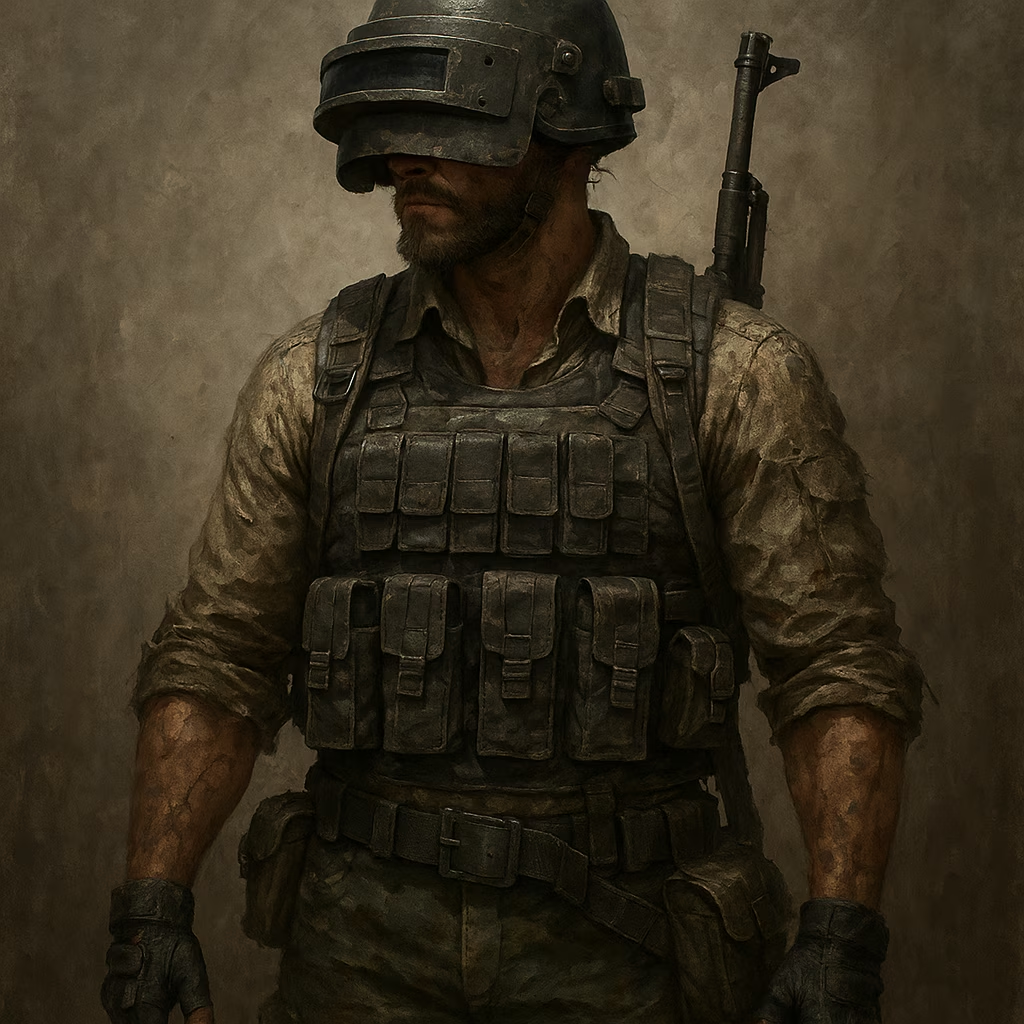
The Lite Life: Sacrifices and Surprises
Playing on Lite was an exercise in creative compromise. Fidelity was the first thing tossed out the window. Textures were simpler, draw distances shorter, and effects less flashy. My character sometimes looked like they were assembled from construction paper, and the Erangel grass resembled a particularly vibrant green carpet. But you know what? It ran. It ran on integrated graphics cards, on laptops that struggled with solitaire. The core loop—the tense looting, the heart-pounding firefights, the mad dash for the circle—was all there, preserved like a fly in amber.
The beta version didn't have all the maps from the main game initially. The development team, which was separate from the main PUBG team, promised to add more over time. This slow rollout felt like getting chapters of a favorite book one by one; it built anticipation. We made do with what we had, and each new map addition was a community holiday.
Let's be clear about what PUBG Lite was and wasn't:
| Aspect | PUBG Lite (Circa 2019-2020 Beta) | PUBG Main Game |
|---|---|---|
| Cost | Free-to-Play 🎉 | Paid 💰 |
| System Reqs | Extremely Low (Potato-Friendly) 🥔 | Demanding (Gaming Rig Needed) 🖥️ |
| Visual Fidelity | Functional, sometimes charmingly crude | High, often stunning |
| Core Gameplay | Identical to the original 🎯 | The original standard |
| Content | Gradually expanding | Complete from the start |
The Legacy in 2026: More Than Just a Lite Version
Looking back from 2026, PUBG Lite's impact was profound. It wasn't just a stripped-down game; it was a philosophical statement. It argued that great gameplay shouldn't be locked behind a paywall and a hardware wall. It democratized the battle royale genre for millions. In a world where games often feel like they're in an arms race for the best graphics, Lite was a refreshing reminder of what matters most.
Its expansion on October 10th all those years ago was a watershed moment. It proved there was a massive, hungry audience that mainstream gaming had ignored. Playing it felt like using a well-worn, perfectly balanced tool—it wasn't shiny, but it got the job done with a satisfying thunk. The community it built was one of camaraderie over shared technological limitations. We weren't just players; we were pioneers on the frontier of minimum settings.
In the end, PUBG Lite was the gaming equivalent of a perfectly brewed cup of instant coffee. Purists might turn their noses up, but when you need that specific flavor and warmth without the fancy equipment, it's an absolute godsend. It showed that you don't need a sports car to enjoy the thrill of the drive; sometimes, a reliable bicycle with a strong sense of momentum is just as exhilarating. It bridged gaps, created memories, and for many of us, was the gateway into a world we thought was out of reach. That's a legacy any game, 'Lite' or not, would be proud to have.