PUBG's Enduring Legacy: From Hotfixes to Hall of Fame Status in 2026
PlayerUnknown's Battlegrounds and PUBG updates have evolved this iconic battle royale into a polished, feature-rich shooter beloved by gamers worldwide.
Just the other day, I was reminiscing about the good old days of PlayerUnknown's Battlegrounds, the game that basically taught an entire generation how to pronounce 'Miramar' and instilled a deep, primal fear of red zones. It's 2026 now, and while the gaming landscape is filled with holographic battle royales and neural-link shooters, PUBG still holds a special, slightly janky place in my heart. It's like that old, comfortable hoodie with a few holes in it—you know it's not the fanciest, but you keep coming back to it. The journey from those early, chaotic days to its current status as a polished, feature-rich titan has been a wild ride, filled with updates that fixed everything from bullets that ghosted through enemies to lobbies that crashed harder than my first attempt at driving a motorcycle on Sanhok.
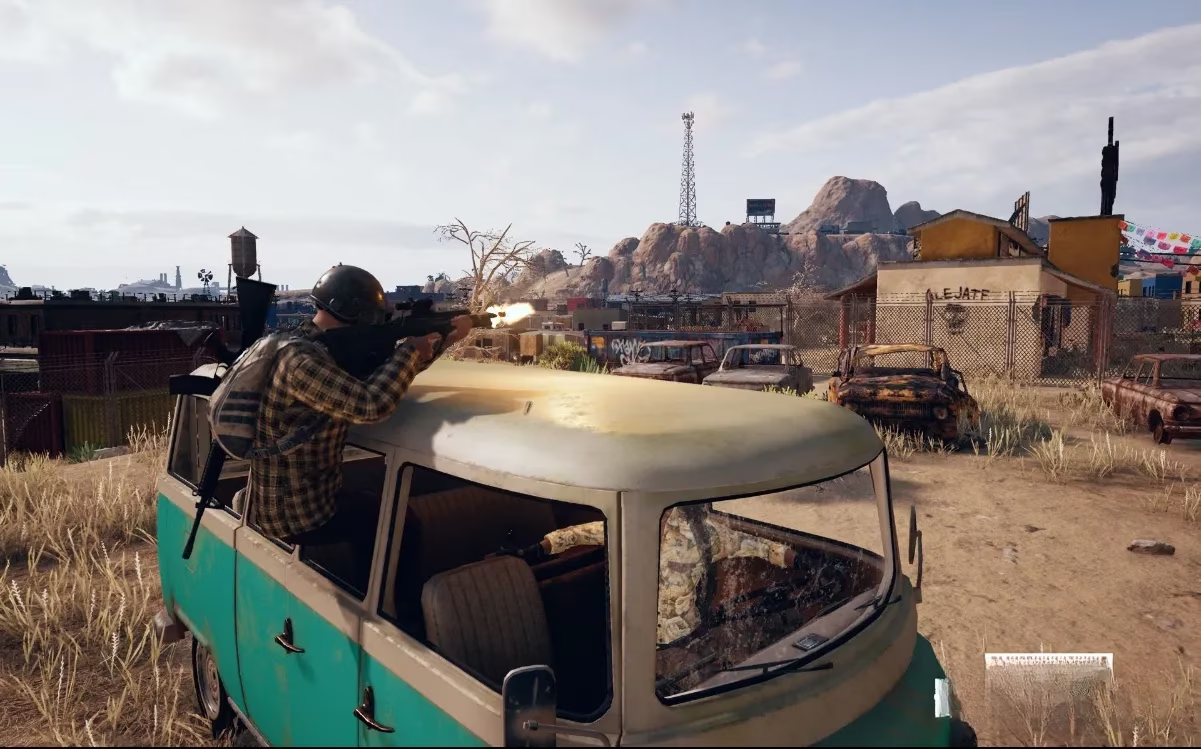
I still vividly remember one particular update, way back when. It was a hotfix that felt like the developers had finally listened to our collective screams into the void. The main villain? The infamous 'hit registration' problem. You'd line up the perfect Kar98 shot from 400 meters, hear the satisfying thwack, see the blood splatter... and nothing. The enemy would just casually stroll away, completely unharmed. It was infuriating! That patch note—'addressed an issue with long-range hits not registering correctly'—was a thing of beauty. It was more than just a fix; it was an apology letter written in code. Alongside that, they tackled the lobby crashes. Nothing killed the pre-game hype faster than your game deciding to take an unscheduled nap while you were trying to squad up with friends. That one-two punch of gameplay and stability fixes was a turning point. It showed they were committed to smoothing out the rough edges, transforming PUBG from a fascinating, broken experiment into a genuinely competitive shooter.
The momentum from those early fixes never really stopped. Think about the features we take for granted now! Shortly after leaving Early Access, PUBG Corp. dropped the Killcam and 3D Replay system. Let me tell you, as someone who spent my first 100 hours dying to mysterious, unseen forces, the Killcam was a revelation. No longer was my death a confusing mystery! I could finally see that the guy who killed me wasn't a hacker, but just someone who had been patiently camping in that bathroom for 15 minutes. The 3D Replay, meanwhile, turned every match into a mini-movie. You could fly around the map like a ghost, analyzing the final circle from every angle, learning how the true chicken dinner winners played their cards. These weren't just add-ons; they were essential learning tools that deepened the game's strategic layer immensely.
Of course, we can't forget the console crew. The Xbox version's journey was its own saga of triumph. The update that introduced flexible squad sizes—letting you roll as a one-man army, a dynamic duo, or a trio without being forced into matchmaking with a random fourth—was a game-changer for console players. It acknowledged that friend groups come in all sizes, and sometimes you just want to play with your two best buddies without getting saddled with 'LeroyJenkins_99' who immediately drives your UAZ off a cliff. This focus on player choice and social flexibility was a huge part of why the game exploded, hitting a million players on Xbox in its first 48 hours. That kind of growth was unheard of for a 'Game Preview' title at the time.
Fast forward to today, in 2026, and PUBG's legacy is undeniable. Let's look at what it cemented in the gaming world:
-
The Blueprint for Battle Royale: It codified the formula—parachute in, scavenge, survive, outlast. The shrinking play zone wasn't just a mechanic; it was a narrative device that forced action and created unforgettable, tense final moments.
-
A Commitment to Polish: It demonstrated that a community-driven, live-service model could work. They listened, they fixed, they added. The game we have now is almost unrecognizably smooth compared to its 2017 ancestor.
-
Cross-Platform Pioneering: While it started separately, the groundwork it laid in balancing and updating different platforms paved the way for the seamless cross-play we expect in modern titles.
Here’s a quick snapshot of its evolution from my perspective:
| Era | Key Challenge | PUBG Corp's Response | Result |
|---|---|---|---|
| Early Access (2017) | Foundational jank, network issues | Core gameplay fixes, anti-cheat | Built a playable, wildly popular core |
| Official Launch (2018) | Lack of post-match tools, stability | Introduced Killcam/Replay, lobby fixes | Added depth, transparency & reliability |
| Console Expansion (2018-2019) | Adapting PC experience for console | Custom squad sizes, optimization patches | Created a thriving, dedicated console community |
| The Modern Era (2020-2026) | Staying relevant in a crowded genre | New maps, constant balancing, community events | Maintained status as a tactical BR benchmark |
So, while I'm now dodging plasma bolts in zero-G arenas or coordinating heists in fully immersive VR worlds, I still boot up PUBG every now and then. The sound of a plane flying overhead, the panic of finding only a pistol and a pan in your first house, the sheer terror and elation of a top-10 situation—it's a classic feeling that newer, shinier games can't quite replicate. It’s a testament to the fact that a great concept, supported by persistent tuning and a respect for the player experience, can endure for nearly a decade. It’s not just a game; it’s a piece of gaming history that we all helped write, one chaotic, buggy, glorious match at a time. 🏆
In the end, PUBG taught us more than just how to loot quickly or control recoil. It taught developers the importance of communication and iteration after launch. It taught players patience (so much patience). And it taught everyone that sometimes, the most rewarding victories come from a game that was willing to grow up alongside its community. Here's to the chicken dinners of the past, present, and future! 🍗