PUBG's Free Xbox One Promotion and the Battle Royale Landscape in 2026
PlayerUnknown's Battlegrounds and Xbox One unite in a groundbreaking free promotion, redefining battle royale gaming and console competition.
In the ever-evolving arena of battle royale games, few titles can claim the foundational impact of PlayerUnknown's Battlegrounds. As we look back from the vantage point of 2026, PUBG's legacy is not just that of a trendsetter but of a digital colossus whose shadow still shapes the genre. A pivotal moment in its console journey was Microsoft's strategic move to offer the game for free on Xbox One, a maneuver as calculated as a grandmaster's opening gambit in a high-stakes chess match. This wasn't merely a giveaway; it was a tactical insertion into the ongoing console wars, designed to capture the hearts, minds, and hard drives of players who had somehow remained on the sidelines of the Erangel and Miramar madness. The promotion, initially a limited-time event, set a precedent for how established live-service giants could refresh their player bases, a lesson the industry has since absorbed like a sponge in a digital downpour.
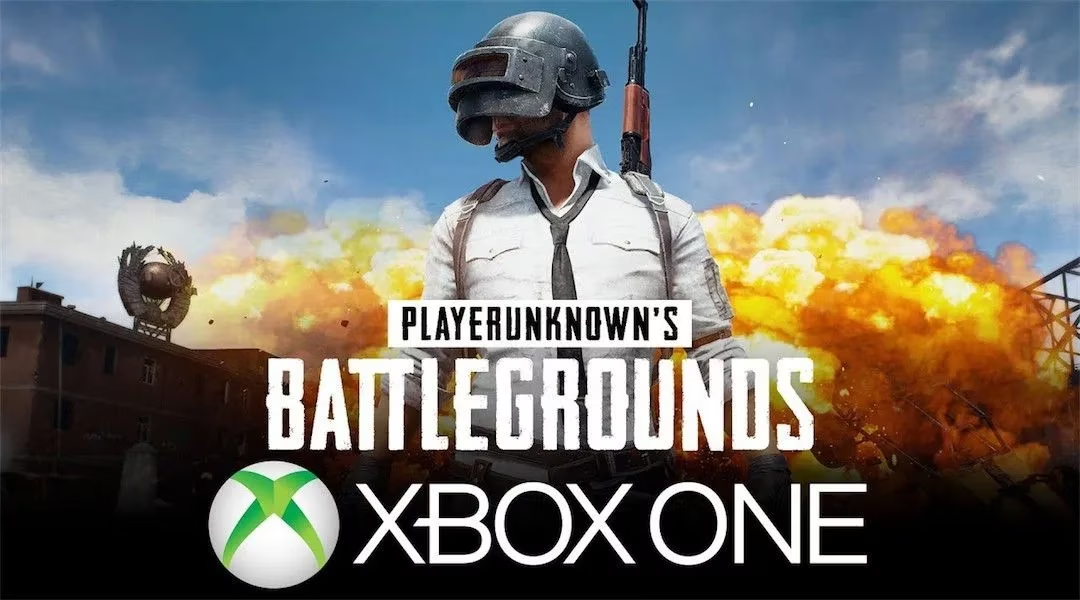
The Freefall Frenzy: Anatomy of a Promotion
Microsoft's decision to make PUBG free for a limited window was a masterstroke in audience acquisition. For a game that had already transitioned from its PC and Xbox Game Preview origins to a full 1.0 release, this was less about testing the waters and more about flooding the zone. The goal was clear: hook anyone still hesitating before the inevitable arrival of the game on PlayStation 4. Think of it as a digital sampler platter at a cosmic food court—once players got a taste of the tense, loot-driven gameplay, the hope was they'd be willing to stick around for the full-priced meal and all its subsequent seasonal updates. The promotion was a direct challenge, a gauntlet thrown down that asked, "Why watch the battle royale from the bleachers when you can be in the trenches?"
From Early Access to Awards Access
PUBG's journey to this point was nothing short of meteoric. Bursting onto the PC scene in early 2017, it was a phenomenon that felt less like a game launch and more like a cultural tremor. Its nomination for Game of the Year at the 2017 Game Awards while still in Early Access was a testament to its raw, captivating power. It was the scrappy underdog that played by its own rules, a formula that resonated deeply. The Xbox One version, launching in preview that December, allowed console players to experience the gritty, unforgiving tension that set PUBG apart from its soon-to-be competitors. By the time it hit full release on Xbox in September of the following year, it had carved out a dedicated niche. The free promotion was a way to expand that niche into a canyon.
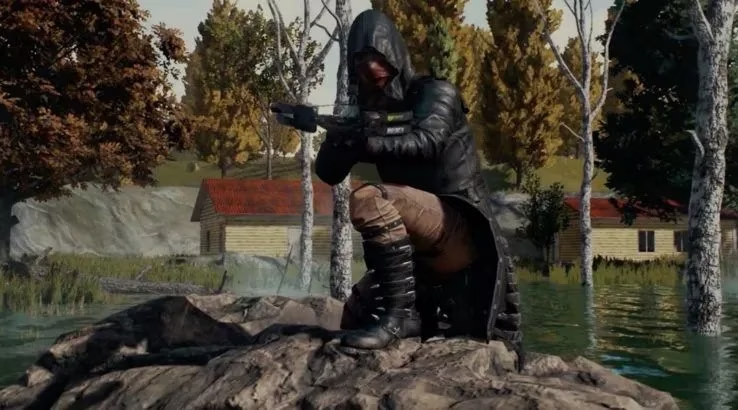
The Exclusivity Gambit and the PlayStation Horizon
A key piece of context for the free offer was Microsoft's timed console exclusivity. In the gaming world, such deals are as common as loot drops in a hot zone, but they always carry an expiration date. With the Korean ratings board already hinting at a PlayStation 4 version, the clock was ticking for Xbox. Making the game free was a brilliant defensive play—a way to build a fortified player base on its home turf before the walls came down. It was an attempt to turn potential PlayStation converts into loyal Xbox soldiers, armed with progress and purchased battle passes. In hindsight, this period was like the calm before a cross-platform storm, where platform holders scrambled to secure their communities before the borders between them became increasingly porous.
PUBG's Enduring Legacy in 2026
Fast-forward to 2026, and the landscape PUBG helped seed has grown into a dense, competitive jungle. Yet, PUBG itself remains a formidable presence. Its realistic ballistics, high-stakes gameplay, and constant evolution have ensured it isn't just a relic but a continuing competitor. The lessons from that Xbox free promotion have been studied and replicated across the industry. Today, we see:
-
Strategic F2P Transitions: Many "finished" games now use limited-time free access as a relaunch tool.
-
Community-First Tactics: Rewarding legacy players while aggressively courting new ones is standard practice.
-
The "Permanent Beta" Mindset: Games are never truly "done," and player acquisition is a continuous campaign.
PUBG's free week on Xbox One was more than a sale; it was a case study in modern game lifecycle management. It demonstrated that in the live-service era, a game's launch is just the first circle of a much larger, ever-contracting play zone. The game's availability across Android, iOS, PC, and Xbox One (and later, of course, PlayStation) ultimately cemented its status as a ubiquitous title. That free drop was a pivotal supply crate for Xbox, packed not with a Level 3 helmet, but with thousands of new recruits ready for deployment. In the grand, chaotic battle royale of the gaming industry, PUBG proved that sometimes, to win the war, you first have to give away the plane tickets for free. 😉