The Evolving Legacy of PlayerUnknown's Battlegrounds: A Tale of Peaks and Shifting Sands
PlayerUnknown's Battlegrounds player count and PUBG concurrent players on Steam reveal a dramatic shift, yet the game remains a legendary force.
The digital winds have shifted since the day when PlayerUnknown's Battlegrounds stood as the undisputed sovereign of the battle royale frontier. Its name once echoed through the corridors of gaming, a clarion call that summoned millions to its unique brand of tactical, survivalist warfare, sparking a genre-wide renaissance and inspiring titans like Fortnite. Yet, by the year 2026, the landscape has transformed. The game's concurrent player count on Steam, a once-mighty river, has seen its waters recede to half the flow from its historic peak of over 3.2 million souls in January years past. Today, the 24-hour peak hovers like a persistent ghost around 1.5 million, a testament to a changed era. The average player count, too, has followed a gentle downward slope, settling at figures that, while still formidable, speak of a kingdom no longer alone on its hill.
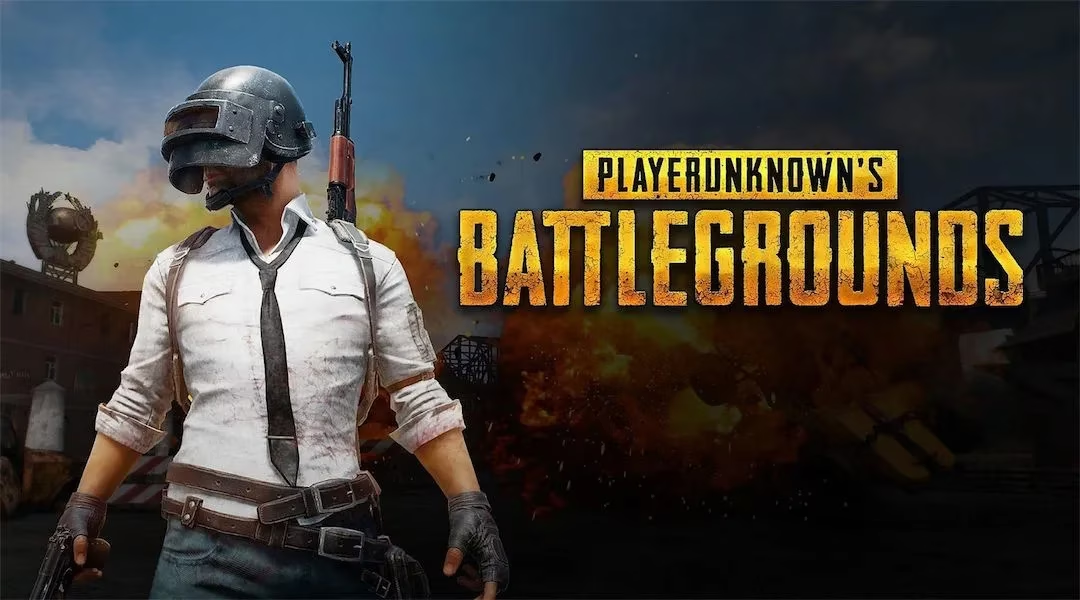
To speak of decline, however, is to tell only half the story. To witness a giant's shadow shorten is not to witness its fall. PlayerUnknown's Battlegrounds remains, by any measure, a colossus in the PC gaming pantheon. Its community is vast, its matches still pulse with tension, and its legacy is etched permanently into the bedrock of modern multiplayer design. The question that lingers, like fog over Erangel, is not one of survival, but of evolution. What currents pulled players toward other shores, even as this original island remained lush and populated?
Several specters haunt this narrative. The most persistent, perhaps, is the plague of cheaters—digital phantoms who could walk unscathed through the lethal blue zone or wield impossible invincibility. PUBG Corp waged a relentless war against these shadows, deploying ban waves and sophisticated anti-cheat systems with the determination of a sentinel. Yet, in an online world, such battles are never fully won; the problem became a recurring thorn, a fracture in the fair-play covenant that some players found too wearying to endure.
Then came the storm from a different direction: the vibrant, ever-changing carnival of Fortnite. Its arrival was seismic. Offering a free-to-play gateway into the battle royale experience, it cultivated a culture of constant metamorphosis, building a universe that extended far beyond the last-player-standing premise. By myriad metrics—Twitch viewership, revenue, sheer cultural saturation—it surged ahead, becoming a global phenomenon. It is a reasonable, almost poetic, assumption that a portion of PUBG's early pioneers were drawn to this new, chaotic canvas, lured by the siren song of novelty and Epic Games' grand vision.
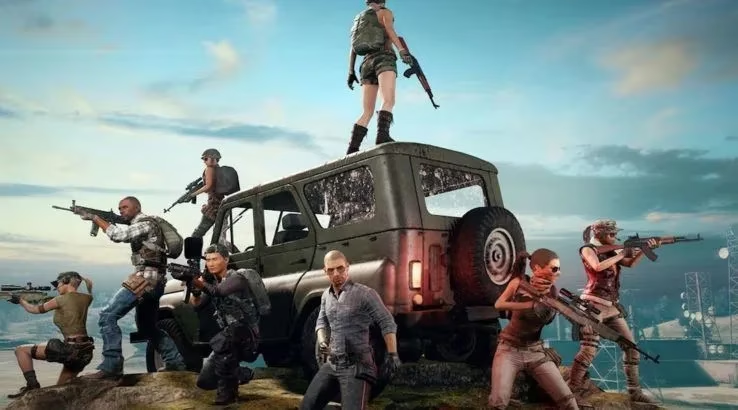
The narrative of competition, though, is but one layer. Player fatigue is a subtle force. The uncompromising, gritty realism that defined PUBG's appeal—the heart-pounding silence, the meticulous loot management, the punishing ballistics—also constructed a high barrier to consistent enjoyment. It is a game of profound highs and crushing lows. For some, the weight of that tension became burdensome over thousands of hours. They sought lighter fare, or different flavors of competition, in a market that had exploded with alternatives inspired by PUBG's own success.
Yet, to focus solely on what has been lost is to miss the enduring flame. The developers' commitment has been the bedrock of its longevity. Through the years leading to 2026, support has never wavered:
-
New Maps & Content: Continual introductions of diverse battlegrounds, each with unique geography and tactical rhythms.
-
Technical Refinement: Ongoing optimization, bug fixes, and graphical enhancements to keep the experience stable.
-
Gameplay Innovations: New weapons, vehicles, and limited-time modes that refresh the core loop without betraying its identity.
-
Community Engagement: Regular communication and event systems that reward dedicated players.
This sustained effort has ensured PUBG is not a relic, but a living, evolving world. It has carved out its own niche—a space for players who crave a specific, unforgiving brand of tactical immersion that newer, faster-paced entrants do not provide. Its player base, while no longer the monolithic peak of yore, has solidified into a dedicated legion.
In the grand tapestry of 2026's gaming ecosystem, PlayerUnknown's Battlegrounds occupies a noble and secure position. It is the seasoned veteran, the origin point from which a genre exploded. Its concurrent player counts are not a eulogy but a map of a settled territory. The exodus of some was inevitable, a natural diffusion following a supernova of popularity. What remains is a game that has successfully transitioned from a viral sensation to a staple—a title with a clear, passionate audience and a roadmap that promises it will remain a relevant force for the foreseeable future. It stands not as a fallen king, but as a revered elder statesman, its golden chest emblem still a beacon for those who seek its particular, potent brand of battle royale purity. Available across PC, mobile, and consoles, its chapter is far from closed; it is simply being written in a different, more enduring ink.